

Critiquing Ourselves to Death
C.S. Lewis on how to approach art and criticism

The way we critique art has much more to say about who we are as people than about the art we find ourselves critiquing.
Let’s be real. I am under no impression that a show, movie, book or piece of art has to speak to everyone in the same way. If it does, we have a different issue at hand. People should have differing opinions on the quality and message of what is created. We are different people, and what speaks to one may not speak to another. But I have been genuinely shocked over the last few years at how people think and speak about the things others create. The visceral reactions of hate, the magnetic draw towards pulling things apart, the natural instinct to assume motives of the artist and the way in which people speak so negatively about (and to) those who enjoy what they do not enjoy — it is all a symptom of an underlying disease that is secretly poisoning our souls and culture.

The internet is a perfect place for people who want to share their opinions. Start a social media account and you are off to the races with your own personal following and audience. Long gone are the days where only a select number of art critics would write up their reviews in newspapers or magazines. We are in the age of democratized critiques, for better or worse. And that means everywhere you turn someone is raging against the current cultural piece of art up for reception.
What disturbs me the most is not that people dislike something. That is natural (though it feels disproportionate at times…but that is probably because negativity sells more in our culture than praise). The disturbance isn’t even in how passionate people get (though it is a bit excessive and unnecessary). What unsettles me the most is how quick we are to throw out the whole because we dislike or disagree with the parts. There is a startling danger in this kind of approach to art and life in general. We are choosing to reject any bit of truth, goodness and beauty that can be received all because something doesn’t fit with our political party, agenda, style or perspective. We analyze and dissect until we have strangled the life out of something, and instead of being nourished and changed by it, we are left with a hollowed out carcass. We have discarded art and what it could do to us in the name of our opinions and judgement.
This leaves me asking a simple question: “Why is this happening?”
Our dear old friend C.S. Lewis helps us out with an answer…
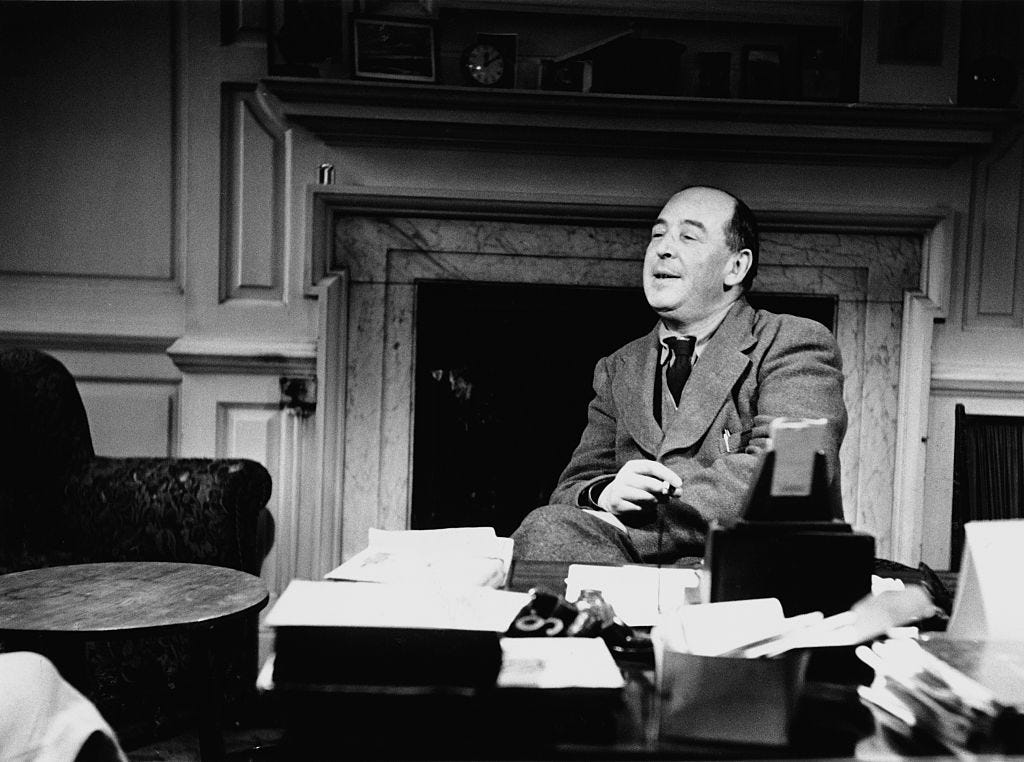
Lewis writes in his book An Experiment in Criticism:
The first demand any work of any art makes upon us is surrender. Look. Listen. Receive. Get yourself out of the way. (There is no good asking first whether the work before you deserves such a surrender, for until you have surrendered you cannot possibly find out.)
Lewis touches on what is one of the greatest ailments in our current climate of criticism. We are no longer surrendering to the art. We do not expect, nor desire, to first look, listen and receive. We cannot fathom getting ourselves out of the way. Rather, we push ourselves to the front and center and instead of letting the art do something to us — confront us, shape us, change us, make us see new things — we put on blinders and use the art as a platform to expound on our predetermined beliefs and perspectives.
I believe this kind of response is robbing people, and our culture at large, of the kind of virtue and beauty that we ultimately desire to see and experience.
Lewis later goes on to say:
The distinction can hardly be better expressed than by saying that the many use art and the few receive it. The many behave in this like a man who talks when he should listen or gives when he should take.
This statement still stands true today. We use art for our own propaganda, whether because we think we see our own validated opinions in it, or because we see the opposite and use it as a reason to shout and rage against the other side of things.
Our destructive way of criticism would lessen tremendously if we stopped long enough to let the art do something to us — even and especially when it rubs us the wrong way or reveals something we don’t agree with. The alternative, of course, is to stay stuck in our online echo-chambers that only like and retweet what aligns with what we say.
If the way we critique has more to say about us than about the art — then our culture is being clearly exposed in its hubris. Like a toddler who thinks they know better than their parents, we stand at the foot of great art only to scoff and whine — missing the truth, goodness and beauty that is being offered to us.
What would it look like for you to surrender, to “get yourself out of the way” and let the art confront and change you into a more mature and virtuous person?
Thank you so much for this post! Interestingly, before I read this, I had just caught up on the May 16 Twitter post by Brivael Le Pogam, who "apologised" on behalf of the French for giving the world Foucault, Derrida and Deleuze, the ideological pillars of "Deconstruction". As a result of their teachings –– he says –– "Une génération entière a appris à déconstruire et n'a jamais appris à construire. Une génération entière sait soupçonner et ne sait plus admirer. Une génération entière voit le pouvoir partout et la beauté nulle part." ––"a whole generation has learned how to deconstruct but never how to construct (to pull down but not to build up); a whole generation has learned how to be suspicious but never how to admire; a whole generation sees power everywhere but not beauty anywhere." So thank God ––and the English?:-)––for giving us Lewis and Tolkien. And thank you for sharing these beautiful words!
Thank you for sharing this and bridging this issue.
It’s one of the best I have read in a long time.
Well done!
Extremely appreciative!